As your Print-on-Demand (POD) business grows, understanding products and printing techniques will help you optimize many aspects of your products, thereby improving quality, optimizing costs, and increasing customer satisfaction.
Knowledge of products and printing techniques will also help you minimize risks when you don't directly handle the products delivered to your customers. This is the deciding factor in controlling product output, ensuring a low refund rate, and maintaining the safety of your account.
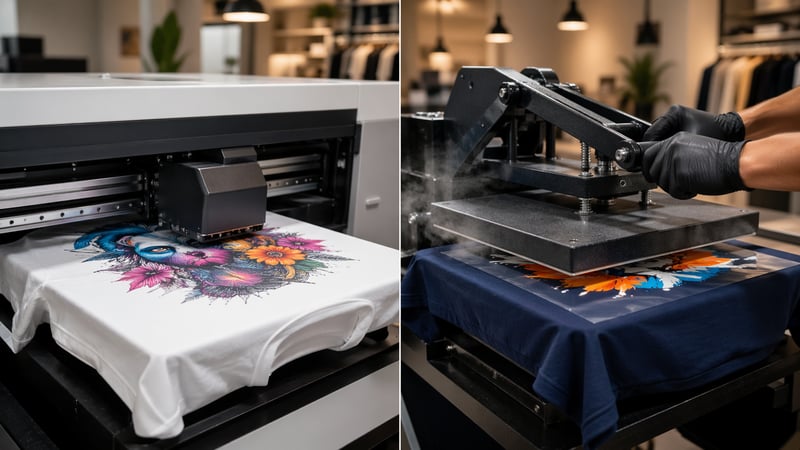
In this article, Dreamship will analyze the two most dominant printing technologies today: DTG (Direct-to-Garment) and DTF (Direct-to-Film). We'll skip the complex technical jargon to focus on the practical question: Which technology works best with which design file and on what fabric?
TL;DR - Quick Summary
- DTG is best for: 100% cotton, gradient/photo designs, premium soft hand feel
- DTF (DTFx) is best for: blended/polyester fabrics, sharp vector logos, high-volume orders
- Dreamship's recommendation: Use both, segmented by product line
In This Article:
DTG: Ink That Soaks Into the Fabric
How It Works
DTG works much like an inkjet printer, spraying water-based ink directly onto the fabric surface. Each cotton fiber absorbs the ink from within, so the print blends seamlessly into the garment without creating any layer on top.
For dark-colored garments, the production facility needs to spray a pre-treatment solution onto the shirt before printing. This step prevents the ink from sinking in when printed on dark fabrics.
What the Product Actually Feels Like
When you run your hand over a DTG print area, you can barely feel the boundary between the print and the fabric. The shirt stays breathable and naturally soft. This is an advantage of DTG printing that many customers choose for their premium apparel.
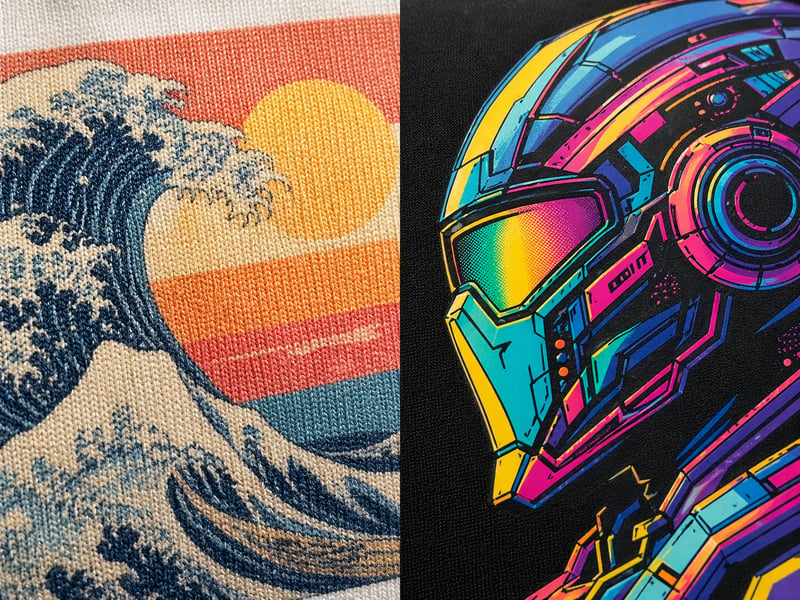
In terms of image quality, DTG produces detailed prints with nuanced color blending, particularly effective on light-colored garments. However, because the ink fuses directly into the fabric fibers, the cotton weave texture bleeds into the design. In practice, the print will pick up the fabric's surface texture, creating a slightly rough or grainy appearance on large smooth color areas, most noticeably on skin tones in portrait designs. DTG colors also tend to be slightly more muted compared to DTF, producing a subtly toned-down look that works beautifully for vintage and retro-inspired designs.
Key Characteristics of DTG
- Soft, breathable hand feel with no raised layer
- Excellent reproduction of gradients and detailed photographic art
- Water-based ink, eco-friendly process
- Ideal for premium, lifestyle-oriented products
- Best results on 100% cotton or high-cotton blends
📖 Read more: 10 Must-Know Facts About the Gildan Heavy Cotton T-Shirt 5000
📖 Read more: Top Best-Selling T-Shirt Bases for Print on Demand
DTF: Heat-Pressed Transfer From Specialized Film
How It Works
Unlike DTG, DTF splits the printing process into two separate stages. First, the design is printed in reverse onto a specialized PET film using water-based ink. Then, a layer of heat-activated adhesive powder is applied to the wet ink surface and run through a dryer to set.
When an order comes in, the facility simply places the pre-printed film onto the garment and heat-presses it at high temperature for a few seconds. The adhesive melts, bonding the design firmly to the fabric.
This two-step process allows facilities to pre-print large volumes of designs on continuous film rolls (Gang Sheets), stockpile them, and press on demand. This is what gives DTF its significant operational speed advantage, particularly useful for maintaining SLA during order surges.
What the Product Actually Feels Like
A DTF print sits on top of the fabric surface. You'll feel a slightly raised, smooth layer with a subtle satin sheen. On first wear, the printed area may feel slightly stiff — this is normal for fresh adhesive and softens naturally after washing.
DTF produces exceptionally vibrant, vivid colors, making it the top choice for designs that demand brightness and color accuracy true to the original file. Because the design is printed onto a flat film surface before heat-pressing onto the garment, DTF reproduces colors more faithfully than DTG, with skin tones and gradients unaffected by fabric texture. However, when it comes to ultra-fine detail reproduction, DTF may not quite match DTG's subtlety. And as mentioned, the DTF print layer sits thicker and more raised on the garment compared to DTG.
Key Characteristics of DTF
- Prints on virtually any fabric (polyester, blends, fleece)
- Highly durable, crack-resistant with premium TPU adhesive
- High production throughput via Gang Sheet preparation
- More vibrant color output (6-color CMYK+)
- Best suited for sharp-edged designs and vector logos
📖 Read more: Preparing the Perfect Design File for Print
📖 Read more: Unlocking Profitability with Comfort Colors 1717
Head-to-Head: Four Factors That Directly Impact Your Orders
| Criteria | DTG | DTF (DTFx) |
|---|---|---|
| Fabric compatibility | 100% Cotton, high-cotton blends | Works on virtually any fabric (Polyester, Fleece, Blends...) |
| Hand feel | Flat, soft, breathable | Slightly raised, smooth satin finish |
| Wash durability | Fades naturally with the fabric (creates vintage effect) | Highly durable, crack-resistant with quality adhesive |
| Best design types | Photo art, smooth gradients, complex details | Vibrant graphics, vector logos, sharp text, solid color blocks |
| Production speed | Requires pre-treatment step for dark-colored garments | High throughput, handles peak-season order surges well |
1. Fabric Compatibility
DTG works best on 100% cotton or high-cotton blends. On these fabrics, ink absorbs deep into each fiber, producing the smoothest, most faithful print results. Conversely, DTF can be printed on any material: polyester sportswear, jackets, fleece blends — all suitable because the design adheres via heat-activated adhesive, with no ink absorption needed.
2. Durability
Both technologies are durable, but in fundamentally different ways.
Because DTG ink fuses directly into the fabric fibers, the print has no raised layer, which means it physically cannot crack or peel. The tradeoff is that colors gradually fade over time, creating a natural vintage effect. For retro and faded aesthetic products, this is a feature, not a flaw. For items where customers expect long-lasting vibrancy, sellers should include clear care instructions (wash inside out, cold water) on the product page.
DTF prints sit on top of the fabric surface, so they retain vivid colors for the long term. Print quality depends significantly on the adhesive powder grade and heat parameters each production facility uses. Within Dreamship's Vetted Partners network, DTFx undergoes strict quality control at intake, ensuring colors stay vibrant and true wash after wash.
3. Design File Configuration
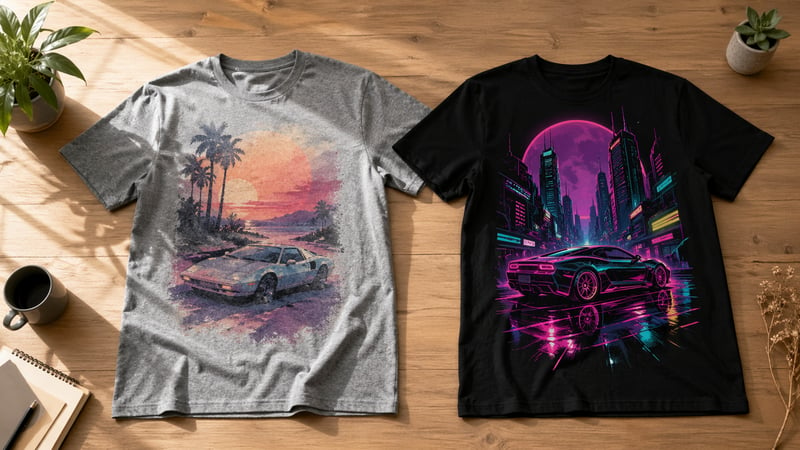
Both technologies accept 300 DPI PNG files, but keep this in mind:
Files suited for DTG
- Photographic images, galaxy/sunset scenes with glow effects and soft fading edges
- Smooth gradients and natural color transitions
- Complex details with many nuanced tones
Files suited for DTF
- Bold typography, hard-edge graphics, solid color blocks
- Vector logos with clearly defined edges
- Designs where vibrant, eye-catching colors are essential
Practical tip: If your file is a photo or soft gradient → go DTG. If it's a sharp vector logo or heavy typography → DTF will produce a more faithful result.
Already have your design file ready?
Upload it to Dreamship and the system will match it to the right DTG or DTFx product for your niche.
Try It Free →Choosing the Right Technology Within Dreamship's System
At Dreamship, we offer both DTG and DTFx technologies through a network of facilities with proven quality. Our Smart Routing system automatically dispatches each order to the nearest production facility for optimal production and shipping times. To identify the printing technology for any product, simply look at the product title in the Catalog: products using DTFx will clearly display "DTFx" in the title, while the rest default to DTG.
Here are some practical examples when building your listings:
Basic cotton tees (Comfort Colors 1717, Bella+Canvas 3001): Defaults to DTG for the best results on natural fiber.
Winter products (Gildan 18500 Hoodie, Jackets, Joggers): Routes to DTF due to high polyester and fleece content.
Understanding each product line and its corresponding material is what helps you select the right SKU from the start, ensuring the final product matches your customers' expectations.
👉 Explore Dreamship's full product Catalog here
Frequently Asked Questions (FAQ)
My new DTG shirt arrived with a slight solvent smell. Is this a production defect?
Not at all. The smell comes from the pre-treatment solution used on dark-colored garments and naturally dissipates after the first wash cycle. For customer service, simply let buyers know a quick machine wash will take care of it.
Does DTF printing make shirts feel too hot?
If a design covers the entire chest area as one large solid block, DTF can reduce breathability slightly in that zone. However, if your design has natural open spaces between text elements or illustrated pieces, the adhesive layer is thin enough that the shirt remains perfectly comfortable to wear.
Why do DTG prints on black shirts sometimes appear darker than the mockup?
Printing color ink on a dark base requires the printer to lay down a white underbase first. At facilities with poor maintenance standards, this white layer can be applied unevenly, causing the final colors to appear dull or muted. At Dreamship, every print facility in our vetted network is required to follow strict periodic calibration protocols to minimize these white underbase inconsistencies.
At the end of the day, no single printing technology is perfect for everything. The right choice depends on your product strategy. If you need a detailed analysis for a specific product or material, don't hesitate to reach out to your Dreamship Account Manager or Support Team.
Wishing you the best product decisions and strong sales ahead with Dreamship!
📚 Related Articles
Unlocking Profitability with Comfort Colors 1717
Why CC1717 is the top-selling premium tee on Etsy, and how to maximize your margin with DTG.
7 Profitable Print-on-Demand Mug Niches
Discover the 7 highest-margin mug niches trending in the US market right now.
Preparing the Perfect Design File for Print
A detailed guide on preparing accurate print-ready files for both DTG and DTF.
One platform for both leading print technologies.
Dreamship supports both technologies with 1–3 day production times, fulfilled in the US. Start with one technology, scale with both.
Explore Dreamship Catalog →🎯 Try Dreamship Plus free for 7 days: drm.sh/848d